
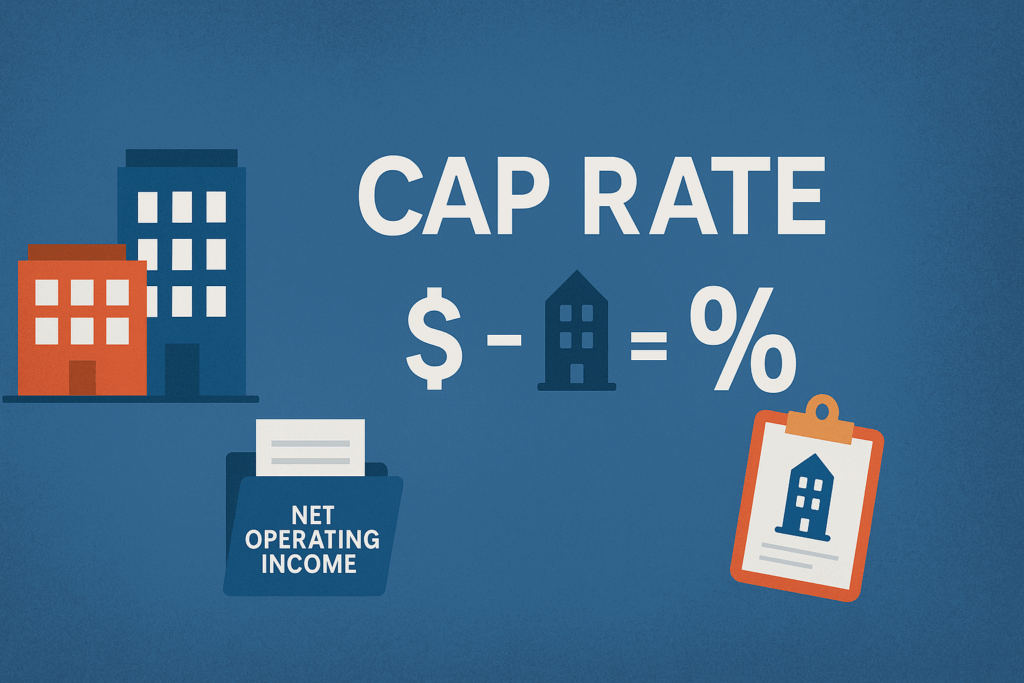
Understanding Cap Rate: A Key Metric in Private Real Estate Investment
For anyone considering private real estate investing, one of the most important terms you’ll encounter is Capitalization Rate, or “Cap Rate.” It’s a simple formula, but it provides powerful insight into a property’s potential performance. At Anchored Funds, we use Cap Rate as one of several tools to evaluate opportunities across asset classes—whether that’s apartment buildings, commercial space, farmland, or residential development.
What Is Cap Rate?
The Cap Rate measures the relationship between a property’s Net Operating Income (NOI) and its purchase price (or current market value).
The formula is straightforward:
Cap Rate = Net Operating Income ÷ Property Value
- Net Operating Income (NOI): The property’s annual income after operating expenses (but before debt service and taxes).
- Property Value: The purchase price or current market value of the asset.
For example, if a property generates $100,000 in annual NOI and costs $1,500,000 to purchase, the Cap Rate is:
$100,000 ÷ $1,500,000 = 6.7%
This percentage represents the property’s unleveraged return (before financing).
Why Cap Rate Matters
Cap Rate helps investors quickly compare properties of different types and sizes. It’s a shorthand way to measure:
- Risk vs. Reward – Higher Cap Rates often mean higher risk but potentially higher returns. Lower Cap Rates suggest stability, but often with lower returns.
- Market Conditions – In hot markets (like Miami multifamily or prime retail in Minneapolis), Cap Rates compress as buyers pay more for reliable income.
- Relative Value – Cap Rate lets you compare a $2M apartment building in Wisconsin to a $10M industrial warehouse in Florida on equal footing.
However, Cap Rate isn’t the whole story. It doesn’t factor in financing costs, tax benefits, or appreciation potential. Still, it’s a powerful first screen for evaluating deals.
Applying Cap Rate Across Property Types
1. Apartment Buildings (Multifamily)
Multifamily investments are often valued by Cap Rate. Investors look for properties with strong tenant demand and predictable NOI.
- In Minnesota or Wisconsin, stable occupancy often means lower Cap Rates (5–6%).
- In Florida growth markets, new development or value-add properties might trade at slightly higher Cap Rates (6–7%) due to greater upside and risk.
2. Commercial / Retail
Retail Cap Rates can vary widely depending on tenant quality.
- A property leased to a national credit tenant (Target, Walgreens) might sell at a low Cap Rate (4–5%) because income is reliable.
- A strip mall with smaller, local tenants may need to offer higher Cap Rates (7–9%) to attract investors.
3. Industrial & Farmland
Industrial warehouses and farmland are increasingly sought after for their steady demand.
- Industrial warehouses (driven by e-commerce) often trade at compressed Cap Rates (4–6%) in major markets.
- Farmland may not generate high immediate cash returns, but Cap Rate combined with appreciation potential can make it attractive as a long-term hedge against inflation.
4. Residential Development
Cap Rate is less commonly applied to raw land or ground-up development, since these projects may not yet generate NOI. However, it’s still useful when evaluating stabilized projections—what the property should yield once it’s completed and leased.
Limitations of Cap Rate
While Cap Rate is useful, it’s not the full picture.
- It doesn’t account for financing structure—leverage can change returns dramatically.
- It doesn’t capture future growth potential (rent increases, redevelopment).
- Market-specific dynamics—like tax laws or tenant demographics—require deeper analysis.
At Anchored Funds, we use Cap Rate as a baseline metric, then layer in cash-on-cash return, internal rate of return (IRR), and long-term appreciation potential to ensure we’re evaluating the full investment story.
Final Thoughts
Cap Rate is a cornerstone of real estate investing—simple, powerful, and versatile. Whether evaluating apartment buildings, retail centers, farmland, or residential developments, it provides a quick snapshot of potential returns and market sentiment.
For investors, understanding Cap Rate is essential to making confident, informed decisions. At Anchored Funds, we go beyond the numbers—using Cap Rate as part of a disciplined approach to identify opportunities that not only build wealth, but also give hope and bless lives.
Because in the end, smart investing isn’t just about returns—it’s about creating lasting impact.
